

Labouchere Strategy for Roulette
There’s no doubt some roulette systems like Martingale or Fibonacci get all the attention. Plus, you have seen them in movies, right? But if you really want to maximize your changes of winning big, pro players often opt for those that give you more versatility. That’s where the Labouchere strategy truly shines, because it mixes the best parts of number-based systems with a much more flexible style.
What is the Labouchere Betting System? The key concept
Let’s start with some basic definitions, and we’ll get into details a bit later. The Labouchere system is a structured and progressive betting strategy really popular in roulette, but also useful in other games with near 50% odds like Blackjack or Baccarat. You may have heard it mentioned as the Split Martingale or the roulette cancellation system, but they are all the same — don’t think those are separate strategies.
All right, so that’s the Labouchere strategy, but how to use it in gambling?
Here’s where you should start paying closer attention. The Labouchere strategy in gambling is about creating a numerical sequence that breaks down the profit you want to get. You can do this adding or crossing out numbers as you either win or lose. You’ll see soon enough this method is fairly flexible and allows you arrange your own sequences — more conservative or more aggressive — as you see fit.
How the Labouchere Strategy Works
Don’t worry, we know you didn’t get how it works yet. We wouldn’t either. But don’t worry, you’ll understand the Labouchere system much better with some examples.
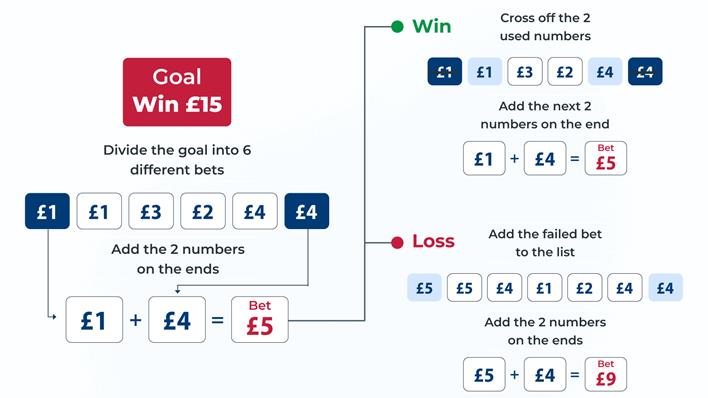
First, you have to decide how much you want to win. Be realistic, and keep your budget in mind. Let’s start with something more affordable — let’s say you want to win $100 betting on red or black. All right. What you have to do for this is create a Labouchere sequence of numbers that add up to 100. For example, 5, 10, 15, 20, 20, 15, 10, 5 = 100.
Now, here’s where things get way different from Fibonacci. Everytime you bet, you bet the sum of the first and last numbers in the sequence, so you’d start by betting 5 + 5 = $10. If you win, you cross out those two numbers — you got those already. But if you lose, you have to add the amount of your bet (those $10) to the end of the sequence, and start over. So, if you lose, your sequence is now 5, 10, 15, 20, 20, 15, 10, 5, 10, and your next bet should be 5 + 10 = $15.
And now you can see where this is going. When you’ve crossed out all the numbers, you’ll have reached your profit goal.
Example of the Labouchere roulette Strategy in Action
I’m pretty sure you already know how this goes, but let’s put this Labouchere system roulette sequence into action by betting six times on red in roulette. Recall that the sequence is 5, 10, 15, 20, 20, 15, 10, 5. Our first bet, then, must take the numbers at both ends — so, 5 and 5.
ROUND 1:
- Bet: 5 + 5 = 10 on red.
- Result: Win.
- Sequence modification: Cross out 5 and 5.
- New sequence: 10, 15, 20, 20, 15, 10.
- Balance: +10
ROUND 2:
- Bet: 10 + 10 = 20 on red.
- Result: Loss.
- Sequence modification: Add 20 to the end of the sequence.
- New sequence: 10, 15, 20, 20, 15, 10, 20.
- Balance: -10
ROUND 3:
- Bet: 10 + 20 = 30 on red.
- Result: Win.
- Sequence modification: Cross out 10 and 20.
- New sequence: 15, 20, 20, 15, 10.
- Balance: +20
ROUND 4:
- Bet: 15 + 10 = 25 on red.
- Result: Loss.
- Sequence modification: Add 25.
- New sequence: 15, 20, 20, 15, 10, 25.
- Balance: -5
ROUND 5:
- Bet: 15 + 25 = 40 on red.
- Result: Win.
- Sequence modification: Cross out 15 and 25.
- New sequence: 20, 20, 15, 10.
- Balance: +35
ROUND 6:
- Bet: 20 + 10 = 30 on red.
- Result: Loss.
- Sequence modification: Add 30.
- New sequence: 20, 20, 15, 10, 30.
- Balance: +5
Got it? Here’s the recap:
| Round | Sequence | Bet | Result | New sequence | Balance |
| 1 | 5, 10, 15, 20, 20, 15, 10, 5 | 5+5 = 10 | Win | 10, 15, 20, 20, 15, 10 | +10 |
| 2 | 10, 15, 20, 20, 15, 10 | 10 + 10 = 20 | Loss | 10, 15, 200, 20, 15, 10, 20 | -10 |
| 3 | 10, 15, 200, 20, 15, 10, 20 | 10 + 20 = 30 | Winn | 15, 20, 20, 15, 10 | +20 |
| 4 | 15, 20, 20, 15, 10 | 15+10 = 25 | Loss | 15, 20, 20, 15, 10, 25 | -5 |
| 5 | 15, 20, 20, 15, 10, 25 | 15 + 25 = 40 | Win | 20, 20, 15, 10 | +35 |
| 6 | 20, 20, 15, 10, 30 | 20 + 10 = 30 | Loss | 20, 20, 15, 10, 30 | +5 |
The Flexibility of the Labouchere System
The Labouchere system is a great strategy not only because it’s simple, but especially because it’s flexible. Numerical sequences in strategies like Fibonacci are fixed, meaning you can’t change the numbers in the sequence at all — you only get to decide your initial bet.Bbut the Labouchere roulette strategy lets you create sequences tailored to your budget, aspirations, and risk tolerance. You can play it conservatively or you can go full in — up to you.
Now, how would those kinds of sequences look? Here are two examples:
- Conservative sequences: I’m sure you can imagine how these would be. All you have to do is use smaller numbers to limit potential losses, although obviously your winnings would also be smaller. For example, if you want to win $50, a Labouchere progression like 2, 3, 5, 5, 5, 5, 5, 5, 5, 5 would be reeeeally conservative because there’s simply no big bets — they are all tiny.
- Aggressive sequences: If you’re happy with an aggressive approach, you can also opt for sequences with higher numbers, so, higher bets. What’s interesting is that your final goal can be the same, $50. An aggressive sequence in this case could be 10 + 15 + 15 + 10. Here you can make more with each bet, but of course if you lose, you lose bigger. That’s the tradeoff.
Simulation Results
But this is not simply a matter of placing larger or smaller bets. Data backs Labouchere more than you’d think — that’s why so many pros keep choosing it. We stretched the example from earlier to 10 rounds and we got fairly nice profits with mixed results: Wins in rounds 7 and 9, and losses in rounds 8 and 10. The back-to-back wins in rounds 6 and 7 made the biggest difference, leaving a sweet +$50 balance by the end of the 10 rounds. And that was the goal, wasn’t it?
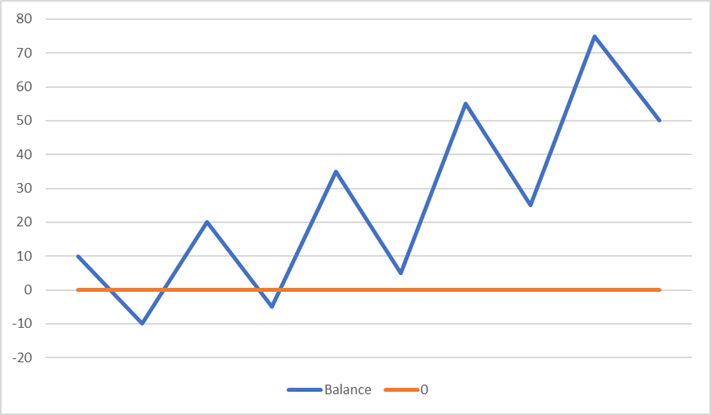
But, disclaimer alert, the Labouchere isn’t a guaranteed win. No strategy is, actually, unless you are a casino instead of a person. Sometimes you can hit a bunch of losses in a row, and that can wipe out your balance with no way back. This will happen with Labouchere, Fibonacci, and any other strategy you may come up with. We don’t sell miracles — we just help you bet better, and make smarter decisions. Here’s one: If your betting money hits zero, the smart move is to call it a day and not chase those losses.
Does the Labouchere System Work?
The Labouchere betting system is handy because it’s an organized way to bet and can be tweaked to fit what you need, but it’s not a surefire way to win. Like with any gambling, it all comes down to the streaks you hit. A few wins can bring in some cash, but a few losses will cost you.
Why it Might Work (Short Term)
This system is mostly built for scoring profits in short gaming sessions. It’s structured, it’s adaptable, and it helps you stay cool and stick to a plan with sequences tailored to your budget and goals. But it doesn’t control the Roulette’s ball, so even the best Labouchere sequence may fail sometimes.
Why it Fails (Long Term)
Take some time understanding the example above, and you’ll see how losing a few rounds can pile up rather quickly, and that obviously leads to losses. If those losses hit early in the Labouchere progression, you’ll have to bet bigger and bigger to recover, which can burn through your budget really fast and end your session early — unless, of course, you hit a couple of wins to recover.
Plus, don’t forget the house always has the edge. In roulette, that’s 2.7% for European tables or 5.26% for American ones. Your Labouchere betting system may be really good, but it will never flip those odds in your favor.
Pros and Cons of the Labouchere Strategy
All right, we’ve made the disclaimer pretty clear — no strategy guarantees wins in roulette. But that being said, the Labouchere technique is actually pretty handy for playing. Here’s what it can give you, and also a couple of setbacks:
Pros
- Gives you a clear, structured way to play, and that’s more useful than you think.
- You can tweak it to fit any budget or goal, and that’s also pretty neat.
- Unlike Martingale, the bets don’t skyrocket as fast, so overall it’s not as risky.
Cons
- It’s a bit more complex than Martingale or Fibonacci, so it’s not great for newbies. You have to keep track of your numbers, so you should go easy with the Martinis.
- Losing streaks can burn through your cash fast, so… don’t lose, I guess?
- Bets tend to get bigger in the later stages of the game cycle, so you may end up betting a good chunk of your profits to a flip of a coin.
Tips for Using Labouchere
If you think this strategy could work for you and want to give it a shot, check out these tips to get started.
- Set a loss limit: Pick a realistic budget and stick to it. Leave some wiggle room for early losing streaks, but cap your potential losses from the get-go. Never go over this budget.
- Stick to 1:1 bets: This strategy only works for even-money bets (like red/black, even/odd). Trying it with riskier bets could rack up big losses fast. Well, not could. Will. Just stick to the basics.
- Don’t stretch your sequence for no reason: If you hit your initial goal, don’t keep playing. Call it a day, and plan the next one. If you keep playing, the house will end up winning.
- Keep strict track of your sequence: The system works when you use it properly. Pay close attention when crossing out or adding numbers. The rules are there for a reason.
- Stay disciplined: Sequences are built to keep emotions out of the game, so keep it that way. Don’t panic after a couple of losses, don’t push your luck after a couple of wins.
Always Play Responsibly
We’ve mentioned it several times already. Having a strategy like a Labouchere roulette system is a solid way to play smart, but at the end of the day, it all comes down to your self-control. Set limits —bettting limits, time limits— and stick to them no matter what. Know when it’s time to call it quits, and take breaks if you need them. If you ever feel like you need help, check out the NCP Gambling website.
Labouchere Strategy FAQs
What if I hit a very long losing streak?
If you get stuck in a long losing streak and run out of budget for the next bet, it’s time to stop. There’s no ifs. Never add more money to your budget to chase losses.
Can I use this system on American roulette?
Yup, you can use it on both American and European roulette since they both have 1:1 bets (like red/black or odd/even). But you’re better off with European roulette—it doesn’t have the double zero, so your chances of winning are slightly better. And it works fairly well in Baccarat too.
Why is this strategy banned in some casinos?
Casinos usually don’t ban numerical strategies like this one. They just have bet limits in place. If your sequence is too aggressive, eventually you won’t be able to place the bet you need — it will be above the table limit.
Can Labouchere be automated?
Well, yeah. It’s a mathematical strategy, so you can automate it with apps like a Labouchere system calculator, or even with a simple Excel spreadsheet. Still, it’s always smart to keep an eye on your bets and not rely totally on automation.
Conclusion
Many players choose the roulette Labouchere strategy not just because it can bring good results, but also because it’s very flexible. It goes beyond strategies like Martingale or Fibonacci because it lets you work with custom sequences. You can tweak to match your budget, risk tolerance, and win goals.
If you like this strategy, start thinking about the different types of sequences — from super conservative to high-risk — and check out online simulations to find the one that better fits your style. If you’re new to this, keep your budget tight and draw a sequence on the conservative side. Or go wild — it’s up to you. Just don’t forget to stick to it, stay disciplined, and always play responsibly!