
Amazing ancient ruins in Africa you’ll love to visit
Ait Ben Haddou Kasbah, Morocco – 11th-17th Century
This is Morocco! And this is the Ait Ben Haddou Kasbah. A kasbah was essentially a fortress, and sometimes a trading hub too! Built between the 11th and 17th centuries, this one is the most iconic of a series of kasbahs placed along the Moroccan trans-Saharan routes – protecting the merchants and travelers of the time, and keeping Morocco nicely invasion-free!
The Kasbah of Ait Ben Haddou was built south of the Atlas Mountains, serving as a gateway to the most prosperous areas of Morocco for merchants coming South or East – from Mauritania, Mali, Senegal, or Ivory Coast, for example. Today, however, it’s just a beautiful sight, but a truly amazing one, especially after it was restored in the past century… for filming a movie!
Volubilis, Morocco – 3rd century
The ruins of Volubilis are much older, dating back to the 3rd century. We’re still in Morocco, but in the north this time. These are the remains of an ancient city that was once part of the Roman trade routes, as you can clearly tell by looking at its well-preserved Arch of Caracalla, multiple Corinthian columns, rich mosaics, and almost untouched urban structure.
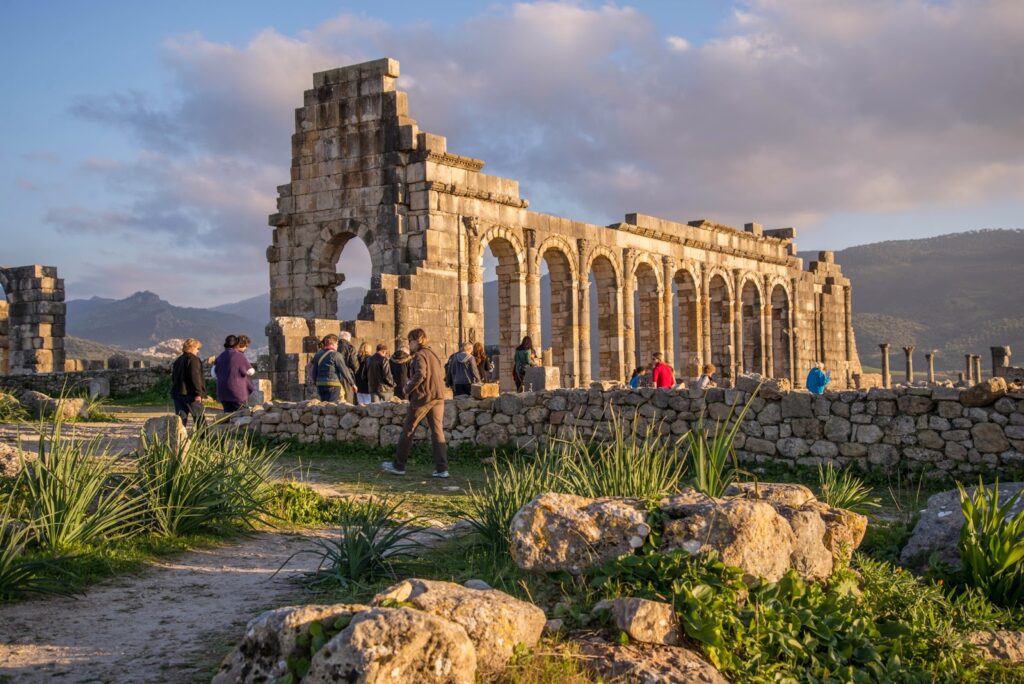
After Rome fell, life in Volubilis gradually changed. It was taken over by the Arabs in the 7th century, and remained an important capital in the region for some more time. However, the Roman trade was key to Volubilis prosperity – With Rome gone, trade networks slowly faded away, and Volubilis shrinked until it was completely uninhabited around the 14th century.
Gedi, Kenya – 13th century
Fortune can shift places, and trade started flourishing around the 8th century along the Swahili coast in East Africa – developing maritime networks with Arabia, Persia, India, and even China! Many prosperous Swahili cities emerged from Somalia to Madagascar, marking an era whose impact on this region still can be felt today.
These are the ruins of Gedi. It was one of Kenya’s most important Swahili ports, boasting a mosque, a palace, and a fortress. Gedi managed to become a powerful economic hub, but successive Portuguese invasions, and the rise of Mombasa as a rival port city – with a remarkably cooler name – ultimately led to Gedi’s abandonment in the 17th century.
Kilwa Kisimani, Tanzania – 10th century
The Swahili trade was particularly vibrant in Tanzania, where the island of Zanzibar became one of the most prosperous cities in all of Africa. This prosperity allowed it to remain relevant to this day, but, as we have just seen, not all Swahili ports had the same luck.
The island of Kilwa Kisimani was also a prosperous commercial hub since at least the 8th century. However, its influence gradually declined after its peak between the 13th and 15th centuries, and it was eventually abandoned two hundred years ago. Kilwa Kisimani had one of the most important mosques in East Africa, was visited by the famous Moroccan traveler Ibn Battuta, and is currently a UNESCO World Heritage Site.
Lalibela, Ethiopia – 700 – 1300 CE
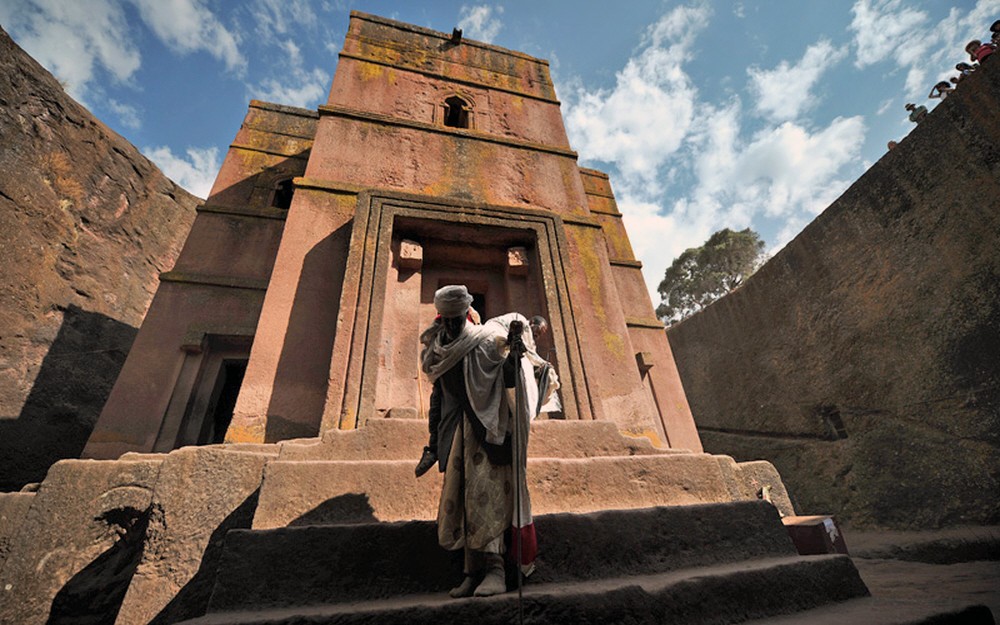
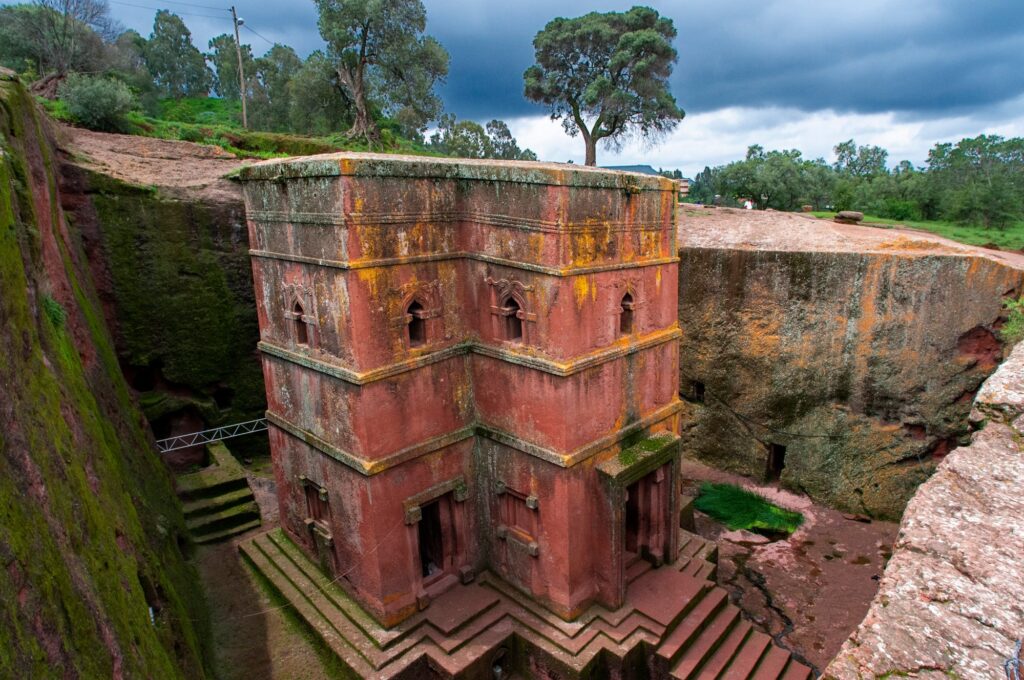
Before heading further south, we should backtrack and make a stop in Ethiopia – home of some of the most fascinating ruins in Africa. These are the rock-hewn churches of Lalibela, built between the 7th and 13th centuries by order of the Ethiopian king Gebre Mesqel Lalibela –obviously. He was a very devoted Christian king who was astonished after visiting Jerusalem, so he decided to create a brand-new Christian hub in his own country.
That’s why these stone-carved churches were made by Ethiopians, not by foreign missionaries, traders or invaders. And since masonry was for amateurs, they decided to carve the churches out of solid rock in one single piece. There are 11 rock-carved churches in Lalibela, including one that remains unfinished. They are still an important pilgrimage destination, and a quite unique place for prayer.
Aksum, Ethiopia – 100 CE
Even older than the ruins of Lalibela are the nearby ruins of Aksum, in present-day Tigray. Aksum was the capital of the Aksumite Empire, which defeated Nubia in the Nubian-Aksumite wars, and became an African powerhouse between the 2nd and 7th centuries – converting to Christianism in the process, and paving the way for the future Lalibela churches.
The decline and eventual fall of the Aksumite Empire, however, led to the abandonment of Aksum after the 10th century. Currently, its ruins are affected by the Tigray War, which is devastating the region since 2020. The current state of the Aksum obelisks, testimonies of a glorious past, remains unknown while Tigrayans endure their most challenging hours.
Meroë, Sudan – 800 BCE
The Kingdom of Nubia was a fierce rival of the Aksumite Empire in their struggle for controlling the Blue Nile. The Nubian civilization flourished between Aksum and Egypt, and the Nubians were so influenced by the Egyptians that they even built their own pyramids! These are the famous pyramids of Meroë in today’s Sudan – Some of them are more than 2000 years old!
There was no such thing as ‘too many pyramids’ for the Nubians, so they built hundreds of them. More than 200 still stand. However, looting and abandonment have hit these structures hard over the centuries. They are still amazing though, aren’t they?
Great Zimbabwe, Zimbabwe – 900 CE
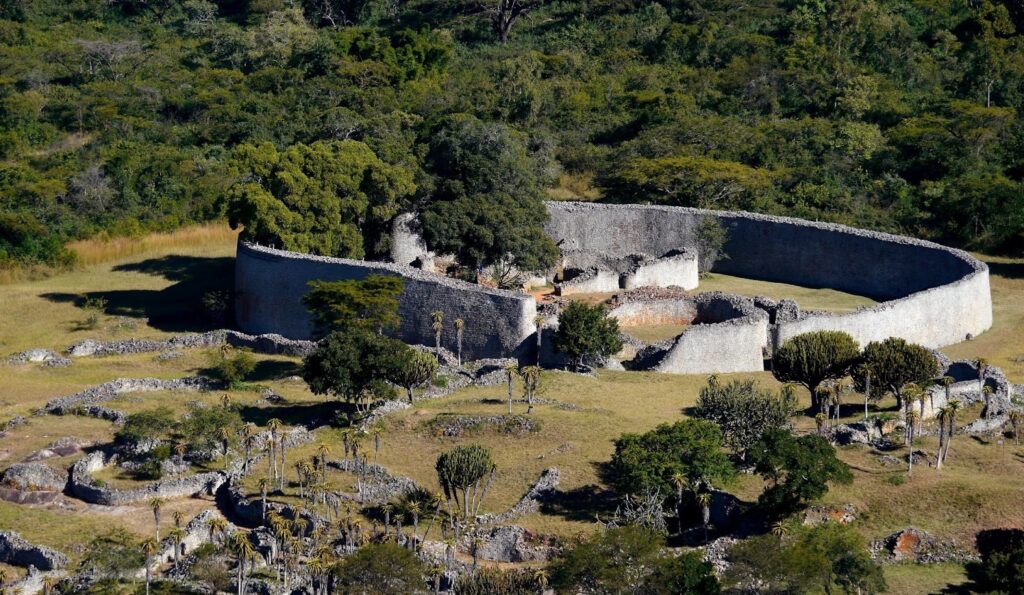
But we’re not done with this one yet! Heading south, you can find the ruins of Great Zimbabwe rising spectacularly in… well, in Zimbabwe! ‘Zimbabwe’ means ‘house of stone’, and there are many of these around this region – The country even adopted the word ‘Zimbabwe’ as its own name! Great Zimbabwe is the largest of these structures, and we believe it was built around the 9th century as a palace and a fortress – not so much as a UFO base, sadly.
Unlike the ruins of Gedi or Kilwa Kisimani, Great Zimbabwe was built entirely by a local culture, and wasn’t influenced by foreigners – not that we know, at least. Today, much knowledge about Great Zimbabwe has been lost. We do think, however, that it was home of the ancestors of the Shona, so Great Zimbabwe remains a majestic legacy for them in southern Africa.
Djado, Niger – 1000 CE
Let’s head back north to the ruins of the ghost city of Djado, in Niger. This ancient city was built near an oasis around the 10th century, probably by the Sao people. The Sao are almost lost to history today, but they managed to extend their civilization to Chad in the East, and Cameroon in the West, making them one of the most influential cultures of ancient Africa.
But, much like Netflix, all empires come to an end. Many Sao people eventually converted to Islam, and many others gradually assimilated into different African cultures after the 16th century. Today, anthropologists think the Sara and Kotoko peoples are descendants of the Sao – Perhaps the ancient city of Djado is part of their legacy after all!
Great Mosque of Djenné, Mali – 1300 CE
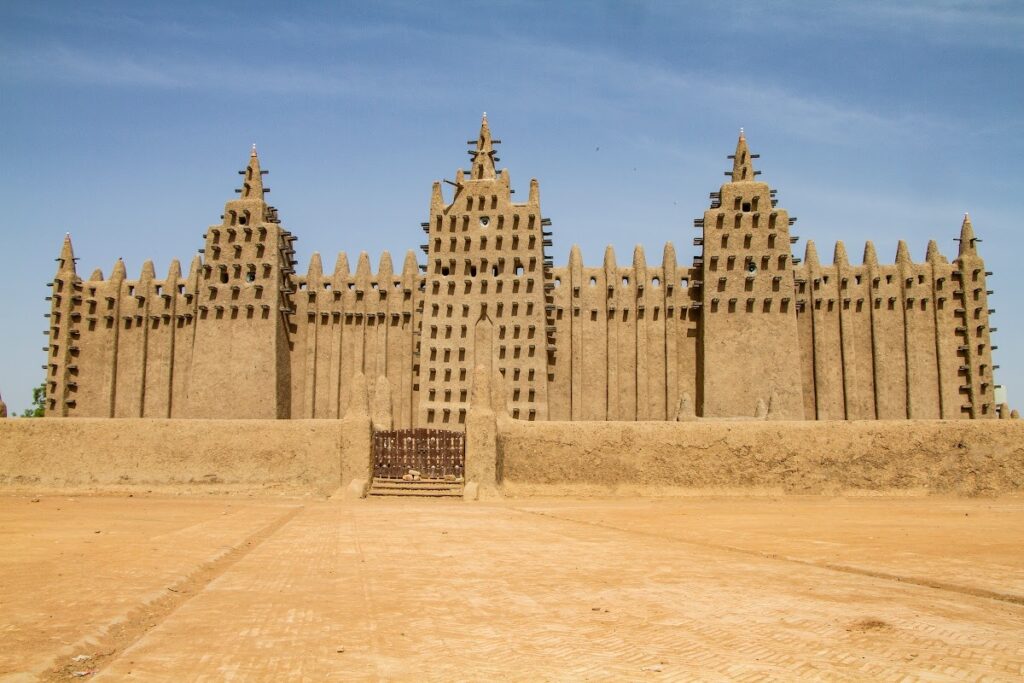
Luckily, other ancient sites are still very much alive! The Great Mosque of Djenné was built in the 13th century, restored in 1906, and remains one of the most important religious places in Mali. It has a truly unique architecture, as it’s built almost entirely with mud. Yes, mud. What Eddie ate as a kid. The city lies between the Niger and Bani rivers, providing a great boost for trade, and… well, also providing a lot of mud.
The history of Djenné goes hand by hand with that of Timbuktu, making it one of the most important cities in trans-Saharan trade – the same trade linking the Moroccan kasbahs from the beginning of this video. Today, Djenné still plays a key regional role, and both the Great Mosque and the old town of Djenné are a UNESCO World Heritage Site. So, not ruins after all!
Bandiagara Escarpment, Mali – 1400 CE
But wait, there’s more! This is the Bandiagara Escarpment, a series of villages built on the Cliffs of Bandiagara by the Dogon people. These villages date back from at least the 14th century, and have remained continuously inhabited to this day. And not just that! The Dogon also excavated a network of tunnels connecting the villages together – They even used them to escape from the French in the 19th century! If only Spaniards had thought about that…
The Bandiagara Escarpment is very close to Djenné, and was a rapidly growing tourist spot until a few years ago. But, since the outbreak of the Mali civil war in 2012, this whole region is very dangerous – and the same goes for the ruins of Aksum and Lalibela in Ethiopia.
Timgad, Algeria – 100 CE
If you want to visit ruins, you can go instead to Timgad, in Algeria. Built in the northern part of the country, Timgad was a military colony founded by the Roman emperor Trajan in the year 100. Yes, the same Trajan from Trajan’s Column in Rome. Your buddy Trajan. Timgad was meant to protect other North African Roman settlements – say Carthage, for example. But Timgad also managed to flourish, and eventually became a prosperous Roman hub itself.
Not for long, though. Timgad was plundered by the Vandals in the 5th century, and the Berbers finished the job some years later. The Byzantines tried to rebuild it shortly after, but there was no case. There were many interesting things to do in the 7th century, and rebuilding Timgad was not one of them. Timgad was finally abandoned in the 8th century, and its ruins remained mostly untouched after that, so its structure has been very well preserved – Lucky for us!
Carthage, Tunisia – 814 BCE
We’d like to finish this video with the ancient ruins of Carthage – for sure one of the most interesting places in the world. Carthage thrived in what is now the city of Tunis, and it was the majestic capital of the Carthaginian Empire. Before the rise of Rome, Carthage controlled the Mediterranean trade with its powerful fleet, later defeating the Romans in the first Punic war, and also winning the second Punic war thanks to a very charming general called Hannibal.
The third Punic War, however, ended with a Roman victory, so the Romans kindly razed Carthage to the ground. Rome then strengthened its presence in Alexandria, Leptis Magna, and Cyrene, gradually fading away the influence of Carthage over the years. And yet, despite this, many of Carthage’s ruins have managed to survive the test of time, including the amphitheater, the baths, and the Tophet – an ancient Carthaginian place of worship.
But the most impressive place in Carthage was, no doubt, the harbor – an extraordinary marvel of ancient engineering, and the actual core of the Carthaginian naval power. Taking advantage of a small natural bay, Carthage’s harbor was fully fortified and arranged around unique circular mooring area – the Cothon. A legendary architectural wonder that, sadly, was never rebuilt.
You can still visit the remains of the Cothon today, and appreciate what once was the most important harbor in the world. The entire area is now just a residential neighborhood with some astray dogs, and one guy who just stares at you. There are no longer walls protecting this place, nor triremes resting on its waters – but the history of Carthage still resonates here, at the true heart of one of the most amazing empires of all time.